Cracking the Code: The "Is It Ready?" Fermentation Guide
Figuring out exactly when your sourdough is perfectly fermented can feel like a stressful guessing game. But you don't need magic or decades of experience to avoid flat or overproofed bread! Successful fermentation is simply about learning the right signs to look for so you can guide the dough effectively.
Infographic
Tap the image to zoom, or download it.
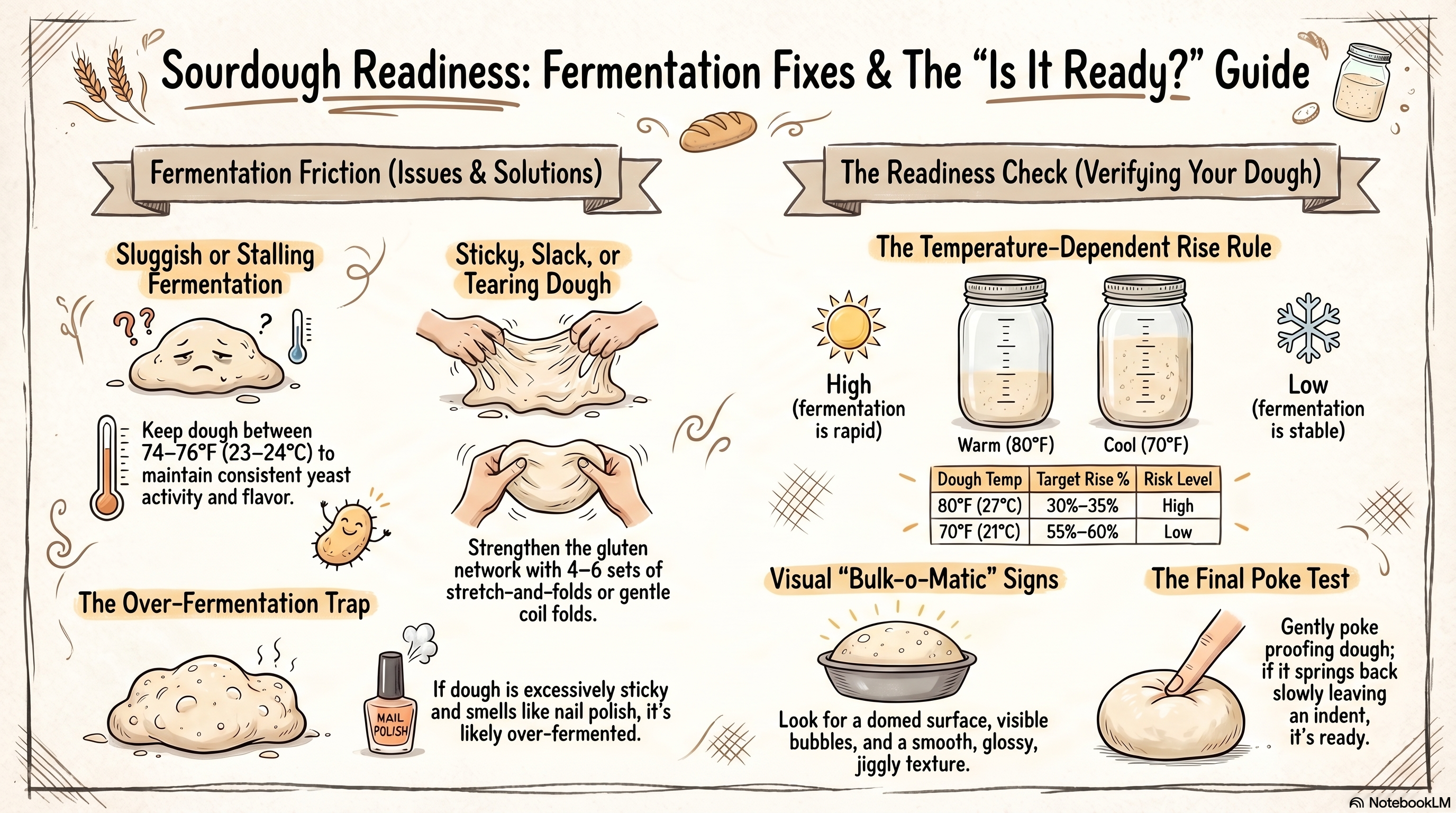
4 Steps to Know Your Dough is Ready
1. Take its temperature
Your dough's temperature is the boss of fermentation. A warm dough ferments significantly faster and has much more momentum than a cool one, meaning it will keep rising even as you shape it.
2. Track the percentage rise, not a double
The target volume increase during bulk fermentation depends entirely on temperature. If your dough is warm (around 27°C / 80°F), you should stop the bulk fermentation at just a 30-35% rise. If it’s cooler (around 21°C / 70°F), you can safely look for a 55-60% rise.
3. Read the visual cues
Besides volume, your dough will show signs of life! Look for bubbles on the surface and a smooth texture. The dough should also pull slightly away from the edges of your container, creating a slightly domed top.
4. Use the "Poke Test" for the final proof
To check if your shaped loaf is fully proofed and ready to bake, use the "poke test". Gently press a wet finger into the dough. If the indentation springs back slowly and leaves a slight mark, it's ready for the hot oven!
Common Pitfalls (What to avoid)
Waiting for the dough to double
Many recipes tell you to let the dough double in volume, but in the sourdough world, this is an almost certain recipe for overproofing into a slack, soupy mess.
Baking purely by the clock
Sourdough does not care about your schedule. Your kitchen temperature changes daily, so rely on the dough's temperature and volume, never the clock.
Pro Tips for Success
Use a straight-sided container: Bulk ferment your dough in a clear, straight-sided vessel. This makes it infinitely easier to track the exact percentage rise.
The magic of the cold retard: After shaping, place your dough in the fridge for 12+ hours for its final proof. The cold temperatures slow down microbial activity, greatly reducing the risk of overproofing while rewarding you with phenomenal ovenspring and deeper flavor.